Business on Top, Chaos Below: America's Greatest Work-From-Home Fashion Achievement
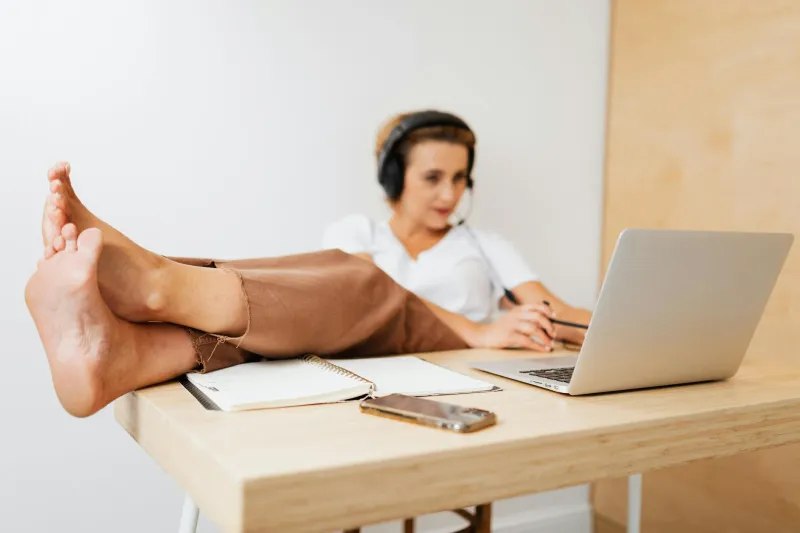
The Great Fashion Divide of 2020
Somewhere between "you're on mute" and "can everyone see my screen," America accidentally invented its greatest fashion innovation since the invention of stretchy jeans. We're talking about the Work-From-Home Mullet — business on top, complete and utter chaos from the waist down.
This isn't just a trend. This is a lifestyle revolution disguised as a wardrobe malfunction, and it's been quietly running the country for four years now.
The Anatomy of Professional Split-Personality Dressing
Let's break down this masterpiece of strategic fashion engineering:
Above the Waist: The Performance
- Pressed button-down shirt (or at least the front half of one)
- Blazer that hasn't moved from its strategic shoulder position in three months
- Jewelry that makes tasteful clicking sounds during important points
- Hair that suggests you're a functioning adult with access to styling products
- Makeup that says "I definitely didn't roll out of bed 12 minutes ago"
Below the Waist: The Reality
- Pajama pants from 2019 that have achieved sentient status
- Mismatched socks (if any socks)
- Slippers that have never seen the outside world
- Underwear situation that we're not going to discuss but everyone understands
- Sometimes pants. Sometimes not. The camera will never tell.
The Psychology of Selective Professional Standards
What's fascinating about the WFH Mullet is how precisely we've calibrated our effort levels. We didn't accidentally stumble into this look — we engineered it with the precision of NASA scientists.
We figured out exactly how much professional appearance we needed to maintain credibility, and then we allocated our resources with ruthless efficiency. Why wear real pants when sweatpants serve the same psychological function? Why put on actual shoes when the act of shoe-wearing is purely performative in a Zoom meeting?
The WFH Mullet represents the most honest relationship Americans have ever had with professional dress codes. We kept the parts that actually matter for communication and ditched everything that was just corporate theater.
The Accidental Genius of Camera-Line Fashion
Here's what's brilliant about this whole situation: we accidentally discovered that most professional dress codes were complete nonsense.
Turns out, you can be just as competent, articulate, and professional while wearing pajama pants as you can in a full suit. Who knew? (Spoiler: everyone knew, but we all pretended otherwise for decades.)
The camera line became the ultimate truth-teller. Everything above it actually affects how people perceive your professionalism. Everything below it? Pure costume.
The Great Zoom Shirt Economy
The WFH Mullet created an entire micro-economy of "Zoom shirts" — tops specifically purchased to look professional on camera while being completely impractical for actual wearing.
These shirts have several key characteristics:
- They only look good from the front
- They're often uncomfortable to wear for extended periods
- They're designed to photograph well under artificial lighting
- They can be put on in under 30 seconds when someone calls an unexpected meeting
- They pair beautifully with pajama pants
The Zoom shirt represents peak efficiency in professional performance. It's fashion as pure function, stripped of everything except its essential communication purpose.
The Slipper Revolution
Let's take a moment to appreciate what happened to American footwear during the remote work era. Collectively, we just... stopped wearing shoes. For years.
Slippers became the unofficial uniform of professional America. Fuzzy slippers, house shoes, those weird sock-slipper hybrids that nobody can properly categorize — they all became legitimate work attire.
Some people went full barefoot. Others invested in "indoor shoes" like they were creating a whole new category of professional footwear. The boldest among us started wearing slippers to video calls and just owned it completely.
The Return-to-Office Reckoning
Now comes the tragic part of our story. Companies are asking people to return to offices, which means returning to full-body professional dress codes. This is asking Americans to give up the greatest fashion innovation of their lifetimes.
The transition back to wearing real pants all day is genuinely traumatic. We've spent years optimizing our comfort levels, and now we're supposed to just... wear shoes? For eight hours? Like animals?
Some people have forgotten how to put together a complete professional outfit. Others have developed psychological dependencies on the comfort of the WFH Mullet. There are Americans who haven't worn real pants to work since 2020, and they're not going quietly into that good night of business casual.
The Hybrid Solution: Mullet 2.0
The smartest remote workers have evolved the WFH Mullet into a hybrid-ready format. They've mastered the art of looking completely professional on camera while maintaining maximum comfort below the frame line.
This advanced version includes:
- Blazers that can be thrown on in seconds
- Button-down shirts worn over pajama tops
- Professional-looking scarves that hide the fact that you're wearing a hoodie
- The ability to transform from "just rolled out of bed" to "ready for the board meeting" in under two minutes
Why This Matters More Than You Think
The WFH Mullet isn't just about comfort — it's about honesty. For the first time in corporate history, we admitted that a lot of professional dress codes were just expensive theater.
We proved that you can be productive, creative, and professional while prioritizing your physical comfort. We demonstrated that the correlation between clothing cost and work quality was mostly in our heads.
Most importantly, we showed that when people are comfortable, they often perform better. Revolutionary concept.
The Future of Professional Fashion
The WFH Mullet has permanently changed how Americans think about work clothes. Even people who've returned to offices full-time now question why certain dress code requirements exist.
We've tasted the freedom of strategic fashion optimization, and we're not going back to suffering in uncomfortable clothes just because someone decided that's what "professional" looks like.
The Work-From-Home Mullet will be remembered as the moment American fashion got honest about what actually matters. Everything else was just expensive cosplay.
So here's to pajama pants, strategic blazers, and the beautiful honesty of only getting dressed from the waist up. You served us well, and you'll always have a place in our hearts (and our bottom drawers).