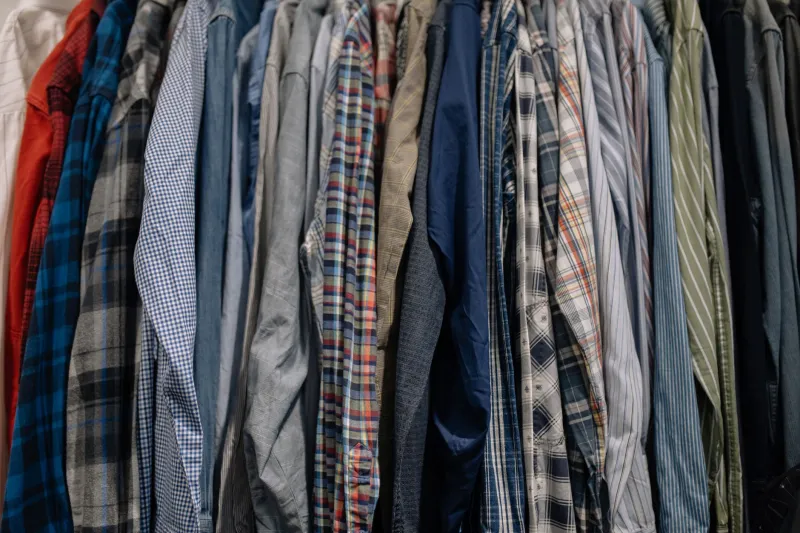
Somewhere between the third unworn blazer and the jeans you're saving for 'when you feel like it,' a truth has been quietly living in your closet, folded neatly between a blouse with the tags still on and a pair of boots you bought because they were 'very you.' That truth is this: your closet is not a wardrobe. It is a museum of intentions. And it's time for an audit.
Not the fun kind of audit. The other kind.
The 11-Piece Rotation You'll Never Admit To
Let's start with the data. If you were to track — truly, honestly track — every item of clothing you wore in a given month, the number would be embarrassingly low. Fashion researchers (yes, they exist, yes, they have opinions about your drawer situation) suggest most people cycle through roughly 20% of their wardrobe on a regular basis. For the average American woman who owns around 100 garments, that means about 20 items are doing all the heavy lifting while 80 others are standing against the wall like kids who didn't get picked for dodgeball.
The 20% that actually gets worn? You know exactly what it is. The grey crewneck. The dark jeans that fit right. The three tops that photograph well. The sneakers you wear until they physically dissolve. That's your real wardrobe. Everything else is cosplay for a version of yourself that apparently has a lot of brunches, charity galas, and ski weekends lined up.
Identifying Closet Deadweight: A Field Guide
Not all unworn clothing is created equal. There is a taxonomy here, and it deserves respect.
The Aspirational Purchase. This is the piece you bought for Future You — a more disciplined, more adventurous, more Parisian version of yourself who goes to jazz bars on Tuesdays and owns a linen blazer that actually fits. You bought it in a moment of genuine optimism. It has never left the hanger. Future You is not coming.
The Sentimental Hostage. This item has no business being in active rotation, but you cannot physically bring yourself to remove it. It's the band tee from a concert in 2014, the dress you wore on a significant birthday, the hoodie from a relationship that ended before the pandemic. You're not wearing it. You're archiving it. Which is fine! Just admit that's what's happening.
The Ill-Advised Trend Victim. You bought this during a very specific cultural moment — perhaps a TikTok spiral, perhaps a week when you were deeply influenced by someone whose aesthetic does not remotely match your life. It seemed urgent at the time. It now sits in the back of your closet radiating quiet shame, like a neon cowboy hat at a tax office.
The Phantom Size. This one fits — technically. Technically being defined as 'if you don't breathe too deeply and avoid sitting down for extended periods.' You keep it because getting rid of it would feel like giving up on something, though you're not entirely sure what.
The Duplicate You Don't Acknowledge. You own four versions of the same basic white tee. You will never wear all four. One of them is slightly better than the others and you wear it exclusively. The remaining three are witnesses.
Why We Refuse to Let Go
Here's where it gets psychological, which is a word nobody wants associated with their relationship to a pair of palazzo pants.
Holding onto unworn clothing serves a function. It maintains the fiction that we are people of range — that we contain multitudes, that we could, at any moment, pivot into a different aesthetic entirely. The velvet blazer isn't just a velvet blazer. It's proof that you could be the kind of person who wears velvet blazers. Letting it go is, in some small and slightly absurd way, letting go of a possible self.
There's also the sunk cost problem, which is just as irrational in a closet as it is everywhere else. You paid $180 for those wide-leg trousers. Getting rid of them without wearing them would mean admitting the $180 is gone. But here's the math nobody wants to hear: the $180 is already gone. It was gone the day you bought them. Keeping the pants doesn't recover the money. It just means your closet is now storing both the pants and the guilt, which is a genuinely bad deal for everyone involved.
A Semi-Serious Framework for Deciding What Stays
Before you spiral into a full Marie Kondo situation, here's a more honest decision-making structure for the average human who does not want to fold their socks into tiny origami rectangles:
The Twelve-Month Rule (For Real This Time). If you haven't worn it in over a year and you cannot name a specific upcoming occasion where you will, it goes. 'Maybe someday' is not an occasion.
The Replacement Test. If this item disappeared tomorrow, would you notice? Would you replace it? If the answer to both is no, that item is not part of your life. It is furniture.
The Honest Occasion Check. For every 'special occasion' piece, ask yourself: when was the last time that occasion actually happened in your life? If the answer involves a year that ended in a different number than this one, reassess.
The 'Future Me' Honesty Hour. Look at the aspirational pieces. Now look at your actual life, your actual schedule, your actual energy levels on a Tuesday night. Is Future You showing up? Be honest. Future You has been promising to show up for years.
What the Audit Actually Gets You
Here's the genuinely useful part, buried under all the self-awareness: a closet full of things you actually wear is a dramatically better experience than a closet full of things you aspire to wear. Getting dressed takes less time. Laundry makes more sense. You stop buying duplicates of things you already own but can't find because they're buried under the palazzo pants.
The closet audit nobody wants to do is, annoyingly, the one that actually helps. You don't have to love every piece you own. You just have to be honest about whether you wear it.
The velvet blazer knows what it did.